





Category: Accounting
The Best Real Estate Accounting Software for Streamlined Bookkeeping
- January 30, 2025
In the competitive real estate industry, managing finances efficiently is critical to success. Whether you are a seasoned realtor or a property manager, real estate accounting software is a game-changer for organizing transactions, tracking income and ensuring tax compliance.
But what is bookkeeping in real estate? It’s the meticulous process of recording financial transactions, tracking analysis, managing budgets, and maintaining accurate records, which are essential for informed decision-making related to properties. Real estate bookkeeping is different from simple bookkeeping which include lease accounting, CAM calculation, Depreciation calculations, property valuation, property tax compliance. With the right real estate bookkeeping software, agents and businesses can achieve seamless financial management.
Let’s explore some of the top solutions tailored for real estate professionals and small businesses.
Why Use Real Estate Accounting Software?
Real estate transactions can be complex, involving commissions, property expenses, taxes, and client payments. Specialized accounting tools streamline these tasks and provide:
- Automated Bookkeeping: Reducing the risk of manual mistakes.
- Tax Preparation: Simplifying tax filing by organizing financial records.
- Scalability: Adapting to the evolving needs of your business.
- Integration: Connecting seamlessly with other business systems like payroll or CRM tools.
For customized bookkeeping solutions, consider Clarigro’s real estate bookkeeping services, which combine professional expertise with advanced software capabilities.
For tailored bookkeeping support, you can also explore real estate bookkeeping services from Clarigro, which combine expertise with software efficiency.
Key Features to Consider in Real Estate Bookkeeping Software
When choosing the right bookkeeping solutions, prioritize these key features:
- Property Management Integration: Link accounting tools with property management software for a unified view.
- Expense Tracking: Categorize expenses by property for accurate reporting.
- Client Invoicing: Generate and track invoices seamlessly.
- Reporting Tools: Analyze cash flow, profitability, and tax summaries.
- Ease of Use: A user-friendly interface saves time and reduces the learning curve.
For more bookkeeping tips and services, visit our comprehensive bookkeeping solutions page.
Best and Reliable Real Estate Accounting Software in 2025
1.QuickBooks Online
Why It Stands Out:
- Offers a wide range of features tailored to small businesses and real estate agents.
- Enables property-based expense tracking and financial reporting.
Perfect For:
Agents seeking bookkeeper accounting software that integrates well with third-party tools.
Limitations:
Customization for real estate-specific needs might require additional setup.
2. Buildium
Why It Stands Out:
- Designed specifically for property managers.
- Combines accounting with tenant management.
Perfect For:
Property managers needing real estate accounting software with advanced reporting.
Limitations:
May not suit smaller businesses focused solely on transactions.
3. Xero
Why It Stands Out:
- Cloud-based platform for efficient bookkeeping and financial tracking.
- Easy to use, with affordable pricing.
Perfect For:
Small businesses needing good bookkeeping software for small business operations.
Limitations:
Lacks some real estate-specific integrations.
4. Propertyware
Why It Stands Out:
- Ideal for large-scale property management.
- Provides tools for tracking rent payments, maintenance costs, and property finances.
Perfect For:
Propertyware helps real estate businesses managing a portfolio of rental properties.
Limitations:
More suitable for larger enterprises.
5. Wave
Why It Stands Out:
- Free accounting software for startups and small real estate agents.
- Offers basic tools for invoicing and expense tracking.
Perfect For:
Those seeking entry-level bookkeeping software for real estate agents.
Limitations:
Limited advanced features for growing businesses.
For expert guidance in selecting the best solution, check out our accounting services page.
- AppFolioWhy It Stands Out:
- Comprehensive property management and accounting tools integrated in one platform.
- Features include rent collection, maintenance tracking, and real-time reporting.
Perfect For: Property managers seeking an all-in-one solution for managing multiple properties.
Limitations: May not suit small-scale businesses due to higher pricing tiers.
- YardiWhy It Stands Out:
- Industry-leading software for real estate accounting and property management.
- Offers advanced features like lease tracking, CAM reconciliation, and robust financial reporting.
Perfect For: Real estate firms handling commercial and residential properties.
Limitations: A steeper learning curve for first-time users.
- MRI SoftwareWhy It Stands Out:
- Flexible and scalable accounting tools for real estate businesses of all sizes.
- Includes modules for lease administration, asset management, and financial modeling.
Perfect For: Enterprise-level property managers needing customizable solutions.
Limitations: Higher cost compared to other software options.
- RealPageWhy It Stands Out:
- Focused on streamlining accounting and property management processes.
- Features include tenant management, utility billing, and portfolio analytics.
Perfect For: Real estate investors and managers seeking efficient portfolio management.
Limitations: Best suited for mid to large-scale operations.
- QuickBooks OnlineWhy It Stands Out:
- Popular and versatile accounting tool for small businesses and real estate agents.
- Includes features for property-based expense tracking and customized financial reporting.
Perfect For: Small-scale agents looking for affordable accounting solutions.
Limitations: Requires additional customization for real estate-specific needs.
The Benefits of Using Specialized Bookkeeping Software
- Time-Saving Automation
No more manual ledger entries—automated tools reduce repetitive tasks.
- Real-Time Insights
Monitor your financial health and make data-driven decisions.
- Improved Compliance
Generate accurate reports for tax filings and audits.
- Scalability
From a solo agent to a growing firm, software grows with your needs.
For those who prefer outsourcing, explore Clarigro’s real estate bookkeeping services for hands-free solutions.
How to Choose the Best Software for Your Needs
1.Assess Your Business Requirements
Do you need a tool for simple bookkeeping or advanced property management?
2. Set a Budget
Free tools like Wave might suffice for startups, while established businesses might need premium options like Buildium.
3. Check Integration Capabilities
Ensure the software integrates with your existing tools like CRM systems or tax software.
4. Consider Scalability
Choose software that supports your growth trajectory.
Why Clarigro Is Your Trusted Partner
When it comes to financial management in real estate, Clarigro offers more than just services—we deliver solutions. With expertise in real estate accounting software and industry-specific challenges, we provide tailored support for agents, property managers and businesses.
Key offerings include:
- End-to-end bookkeeping services.
- Strategic financial planning for real estate businesses.
- Seamless integration with leading accounting tools.
Visit our accounting services page to explore how we can support your financial needs. Outsourcing services, like those offered by Clarigro, combine expert management with advanced software for optimal results.
Conclusion:
Investing in the right real estate accounting software can transform how you manage finances, improve compliance, and save time. From automating tasks to offering real-time insights, these tools are indispensable for agents and property managers alike.

Ready to optimize your bookkeeping? Explore our accounting services and see how Clarigro can help you achieve financial clarity and growth.
Bookkeeping Clean Up: Challenges, Tips and Mistakes to Avoid
- January 27, 2025
Managing your business’s finances is essential to ensure sustainable growth, but bookkeeping tasks often fall behind due to day-to-day priorities. This can lead to disorganized financial records, inaccurate data, and potential compliance issues. To prevent these challenges from affecting your business, investing in bookkeeping clean up services can be transformative. At Clarigro, we specialize in cleanup and catchup bookkeeping, offering solutions tailored to your unique needs.
Whether you are a small business owner or manage a large enterprise, catching up on overdue financial records requires a structured approach. To learn how to keep your books accurate and compliant, explore our bookkeeping clean up services.
How to start cleanup for messy books
- Identifying missing or unorganized receipts or invoices
- Observed irregular reconciliations of bank statements and credit cards
- Signs of personal expenses mixed with business expenses
- Incomplete or inaccurate financial records
- Unable to produce financial reports with incomplete bookkeeping
- Forecasting tax payments and budget vs actual variance
- Difficulties in Audit preparation task
- Cash flow projection issue
Why Bad Bookkeeping or Bookkeeping Clean Up Services Are Vital for Your Business
1.Achieving Financial Accuracy
Messy financial records lead to discrepancies that can distort your understanding of profits, expenses, and cash flow. Accurate financial data is critical for building trust with stakeholders and creating a strong financial strategy. Cleanup services help ensure every transaction is correctly categorized, so your records reflect the true state of your business. Clean financial records ensure accurate decision-making and help avoid potential compliance issues. Learn more about maintaining accurate business records on the IRS’s Recordkeeping for Businesses page.
2. Easing Tax Compliance
Unorganized financial records can result in missed deductions, underreported income, and compliance penalties. A thorough cleanup ensures your books are tax-ready, reducing the likelihood of audits. With services like virtual bookkeeping or remote bookkeeping, you can have experts keep your tax filings error-free.
3. Improving Business Decision-Making
Clean and up-to-date financial records provide a reliable foundation for analyzing your business’s financial health. This insight empowers you to make informed decisions, whether it is about scaling operations, cutting costs, or planning for growth.
Businesses in major regions, including District of Columbia, Texas, Los Angeles, and others, can access our local services for personalized support.
Challenges in Cleanup and Catchup Bookkeeping
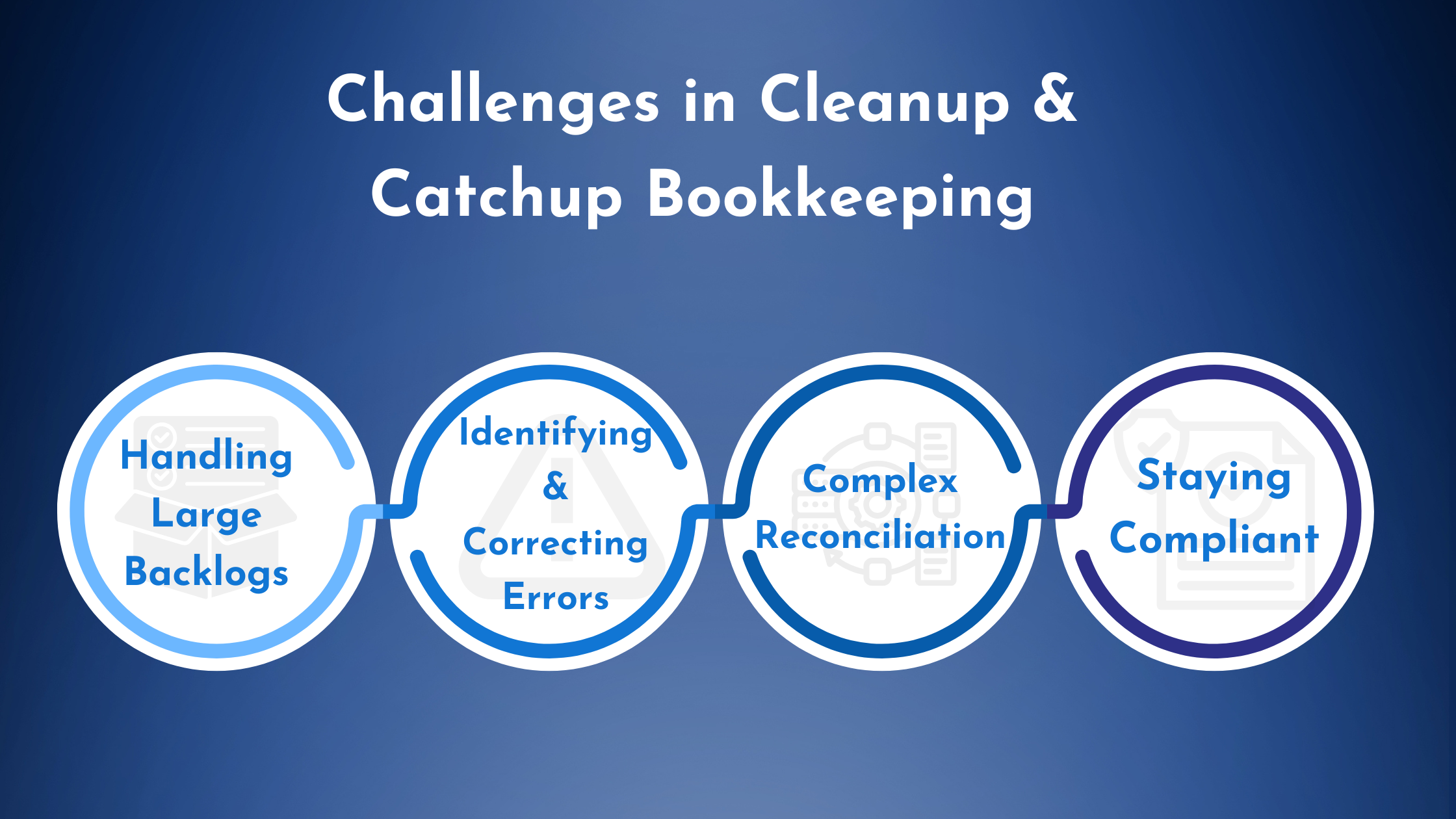
- Handling Large Backlogs
Businesses often delay bookkeeping, leading to months—or even years—of unrecorded transactions. Sorting through these records can be time-consuming and overwhelming without professional help. Using tools like QuickBooks, alongside offshore accounting services, can ease the process by automating data entry and categorization.
2. Identifying and Correcting Errors
Mistakes such as duplicate entries, missed invoices, or incorrect categorizations are common in neglected bookkeeping. Finding these errors requires meticulous reconciliation of bank statements, financial reports, and receipts, which is best handled by experts in catch up bookkeeping.
3. Complex Reconciliation
Bank and credit card reconciliation involves matching financial records with actual transactions. The process becomes more complex when records span multiple accounts, payment methods, or locations. Experts in bookkeeping services for small businesses can ensure reconciliation is done accurately.
4. Staying Compliant
Every business must comply with tax laws and reporting regulations. Outdated or incomplete financial records can lead to hefty penalties. Our team at Clarigro specializes in bringing records into compliance quickly and efficiently.
Tips for Effective Bookkeeping Cleanup
- Use Accounting Software
Software like QuickBooks, Xero, Wave or Sage can streamline the cleanup process by automating repetitive tasks. These tools reduce errors, improve accuracy, and offer detailed reports. Pairing these tools with outsourcing accounting services for small businesses provides an added layer of expertise.
2. Organize and Categorize Transactions
Categorizing expenses and income correctly is essential for accurate reporting. Grouping similar transactions under predefined categories helps identify patterns in spending and ensures compliance with accounting standards.
3. Focus on Reconciliation
Reconciliation is critical for ensuring your financial records match your actual transactions. Regular reconciliation helps identify missing or duplicate entries early on, simplifying the cleanup process.
4. Start with Older Transactions
Starting from older transactions allows you to address historical discrepancies first. This approach ensures that your current records are built on an accurate foundation, reducing errors in your ongoing bookkeeping.
5. Engage Professionals
Partnering with professionals for bookkeeping clean up services ensures that the process is handled efficiently and with minimal disruption. At Clarigro, our bookkeeping services are designed to handle complex catchup and cleanup tasks for businesses across industries.
Common Mistakes to Avoid During Cleanup
- Ignoring Reconciliation
Skipping reconciliation can result in discrepancies that compound over time, making future cleanups more difficult. Regular reconciliations are key to maintaining accurate records.
2. Relying on Manual Processes
Manually updating books is prone to human error. Automation and virtual bookkeeping services can save time and improve accuracy by eliminating manual entry mistakes.
3. Missing Documentation
Without proper documentation, it becomes challenging to verify transactions. Always retain receipts, invoices, and contracts, and digitize them for easy access.
4. Delaying the Process
Procrastination only adds to the problem. Tackling bookkeeping cleanup sooner rather than later ensures smoother operations and prevents further complications.
5. Overlooking Professional Help
Attempting to handle cleanup in-house can lead to inefficiencies. Hiring professionals—such as Clarigro’s remote bookkeepers or accountants for small businesses—saves time and ensures compliance.
Benefits of Outsourcing Bookkeeping
Outsourcing bookkeeping tasks comes with numerous benefits:
- Cost-Effectiveness
Hiring in-house accountants can be costly, especially for small businesses. Outsourcing to experts like Clarigro offers high-quality service at a fraction of the cost.
- Expertise on Demand
Outsourcing gives you access to seasoned professionals who understand tax laws, accounting standards, and industry-specific practices.
- Time Savings
By delegating bookkeeping tasks, you can focus on growing your business while professionals handle your finances.
- Scalable Solutions
Outsourcing services are flexible, allowing you to scale up or down based on your needs. Whether you require ongoing support or a one-time cleanup, Clarigro provides customized solutions.
Our CPA Accounting Outsourcing page offers more details about our scalable services for businesses of all sizes.
How We Can Help With Bookkeeping clean up services
At Clarigro, we simplify Bookkeeping Clean Up Services by implementing diagnostic report and checklist for catchup bookkeeping process with tailored solutions. Here’s how we can assist:
- Detailed Financial Review: We identify discrepancies, categorisation errors, data entry errors, unreconciled items and missing transactions to restore accuracy in your records.
- Customized Cleanup Plans: Our approach is tailored to your business needs, ensuring efficient and effective cleanup.
- Comprehensive Services: From offshore accounting to outsourcing accounting services for small businesses, we offer a wide range of services to fit your requirements.
- Expert Support Across Locations: With a presence in cities like Knoxville TN, Boise ID, and Ft. Myers-Naples FL, our local services ensure we’re close to where your business operates.
Visit our accounting services page to explore the full range of solutions we offer for bookkeeping and beyond.
Conclusion
Cleanup and catchup bookkeeping are critical for maintaining financial health, ensuring compliance, and making informed business decisions. With professional support from Clarigro, your financial records can be transformed into a reliable asset for your business.
Start your journey to better financial management with our bookkeeping clean up services. Visit Clarigro’s bookkeeping services page today to learn how we can help you streamline your business operations.
What Is a 1099 Form, and How Do I Fill It Out?
- January 16, 2025
If you’re a business owner or freelancer, understanding the 1099 form for contractors is crucial for accurate tax reporting. This essential tax document is used to report payments made to independent contractors and freelancers for services rendered. Filing the 1099 form correctly ensures compliance with IRS regulations, avoids penalties, and keeps your finances on track.
In this blog, we’ll break down what a 1099 form is, how to fill it out, and answer common questions like “Is an I-9 form the same as a 1099?” and “How to create a 1099 form in QuickBooks.” We’ll also provide useful insights into managing contractor taxes and even highlight the benefits of outsourcing tax preparation services.
What Is a 1099 Form?
A 1099 form for independent contractors is a tax form issued by businesses to report payments of $600 or more made to contractors or freelancers in a tax year. Unlike traditional employees, contractors don’t receive a W-2 form because they are not subject to payroll tax withholding.
The 1099 form is a critical document for both businesses and contractors, as it helps the IRS track income not reported through payroll. Common types of 1099 forms include:
- Form 1099-MISC: Used for miscellaneous income like rents, royalties, or non-employee compensation.
- Form 1099-NEC: Primarily used to report payments made to independent contractors or other non-employees.
- Form 1099-S: Used to report real estate transactions.
Filling out a 1099 Form for Contractors can seem intimidating, but breaking it into steps simplifies the process. Here’s a detailed guide:
Filling out a 1099 form can seem intimidating, but breaking it into steps simplifies the process. Here’s a detailed guide:
- Gather Necessary Information
Before you start, you’ll need:
- Contractor’s name and address.
- The contractor’s Taxpayer Identification Number (TIN), is usually provided on a W-9 form.
- The total payment made to the contractor over the tax year.
- Choose the Right Form
- Use Form 1099-NEC for non-employee compensation.
- Use Form 1099-MISC for other payments like rent or legal services. Refer to the instructions for form 1099-MISC for details.
- Fill Out the Form
- Enter your business information, including your TIN.
- Provide the contractor’s information and total payments made.
- Report non-employee compensation in Box 1 of the 1099-NEC or use the relevant box on the 1099-MISC.
- Submit to the IRS and the Contractor
- Submit the 1099 form to the IRS no later than January 31st..
- Send a copy to the contractor for their records.
- How to Send a 1099 Form
You can send the form via mail or electronically. For e-filing, consider using software like QuickBooks.
6. When Are 1099s Issued?
The issuance deadlines for 1099 Form for Contractors vary depending on the type of form. For instance, Form 1099-NEC is due by January 31 each year. If January 31 falls on a non-business day, the deadline shifts to the next business day.
Deadlines for Sending 1099 Forms
If you’re responsible for sending 1099 Form for Contractors:
- Recipients must typically receive their 1099 forms by January 31.
- For paper filing with the IRS, 1099 forms must be postmarked by February 28.
- If filing electronically, such as through tax software like TurboTax, the forms can be sent to the IRS with automated imports of the required information.
- Form 1099-NEC is an exception. It must be sent to both recipients and the IRS by January 31, whether filed electronically or on paper.
Why Are 1099 Deadlines Early?
Payers are required to send 1099 forms early in the tax season to ensure:
- Recipients have sufficient time to prepare and file their tax returns.
- The IRS has accurate records of income received during the tax year to cross-check reported income.
These early deadlines assist the IRS in detecting refund fraud and verifying the accuracy of tax filings.
For more information, explore the various types of 1099 forms below.
How to Generate and Print a 1099 Form in QuickBooks
If you use QuickBooks for bookkeeping, you can streamline the process of creating and printing 1099 forms. Here’s how:
- Go to Payroll & Taxes in QuickBooks Online.
- Select Prepare 1099 Forms and follow the guided process.
- Enter contractor payment details.
- Print or e-file the form directly from QuickBooks.
For detailed instructions, check out the QuickBooks Help section on how to print 1099 forms in QuickBooks Online.
What Should You Do if There’s an Error on Your 1099 Form?
If you notice an error on your 1099 form, it’s important to act quickly. Contact the business that issued the form as soon as possible and request a correction. In many cases, they can resolve the error before submitting the incorrect 1099 to the IRS.
For employers who’ve submitted an incorrect 1099 form, filing a corrected version is essential. Use the same method as the original submission and send an updated copy to the contractor so they can accurately file their taxes.
To avoid these errors and ensure compliance, consider hiring professional tax preparation services like Clarigro. A trusted expert can help manage your filings, minimize mistakes, and maximize deductions.
Looking to save on taxes? Check out our Self-Employed Tax Deduction Calculator for Contractors to uncover potential tax savings.
Simplify your tax process and avoid headaches with professional support from Clarigro.
Common Questions Asked About the 1099 Form
Is an I-9 Form the Same as a 1099?
No, an I-9 form and a 1099 form are entirely different.
- The I-9 form is used to verify a worker’s eligibility for employment in the U.S. and is filled out by employees.
- A 1099 form is a tax reporting document for payments made to independent contractors.
What Is a Form 1099-S?
Form 1099-S is used to report real estate transactions. If your business deals with property sales, this form is necessary to report payments from those transactions.
How to Fill Out a W-8 Form?
A W-8 form is used by non-U.S. individuals or entities to certify their foreign status and claim treaty benefits, avoiding double taxation. For example, if you work with international contractors, they may need to submit a W-8 form instead of a W-9.
Why Outsource Tax Preparation Services?
Managing contractor payments and taxes can be overwhelming, especially during tax season. By opting for outsourced tax preparation services, you can:
- Save time and reduce errors.
- Stay compliant with IRS regulations.
- Focus on growing your business instead of worrying about tax filings.
At Clarigro, we offer expert tax preparation services tailored to meet your business needs. Learn more about our accounting and tax return services here.
Benefits of Using QuickBooks for 1099 Filing
QuickBooks simplifies the 1099 form for contractors filing process with features like automatic calculations and e-filing. It’s especially helpful for businesses with multiple contractors. Here’s why you should consider it:
- Saves time with automated tracking.
- Reduces errors with pre-filled data.
- Allows seamless e-filing to the IRS.
If you’re unsure about setting up QuickBooks, our team at Clarigro can guide you.
Final Tips for Filing 1099 Forms
- Double-Check Contractor InformationAlways verify TINs and payment details to avoid errors.
- File on TimeMissing the IRS deadline can result in penalties.
- Use Digital ToolsLeverage tools like QuickBooks to make the process efficient.
- Consider Professional HelpOutsourcing tax preparation ensures accuracy and peace of mind.
How can we assist in outsourcing the 1099 form?
Clarigro has the best bookkeeping and tax experts and professionals that provide comprehensive module solutions for all the outsourcing 1099 reporting services which include 1099-MISC, 1099-INT, 1099-DIV, 1099-R, 1099-NEC, etc. We will help you every step of the way with all of your 1099 filing requirements.
Clarigro is one of the most top leading outsourcing accounting and bookkeeping companies that provide 1099 e-file services to small business owners.
Outsourced Accounting Solutions Year-End Checklist: Prepare for a smooth 1099 form for contractors reporting season with our comprehensive year-end checklist. This checklist helps to simplify year-end tasks and reduce the risk of errors by covering key steps like vendor record updates and payment categorization. Identify who needs a 1099, learn how to clean up your books and review payments and transactions. Contact Clarigro for further information.
Refer to our checklist for more information: 1099 Preparation Checklist 2025_Clarigro
